




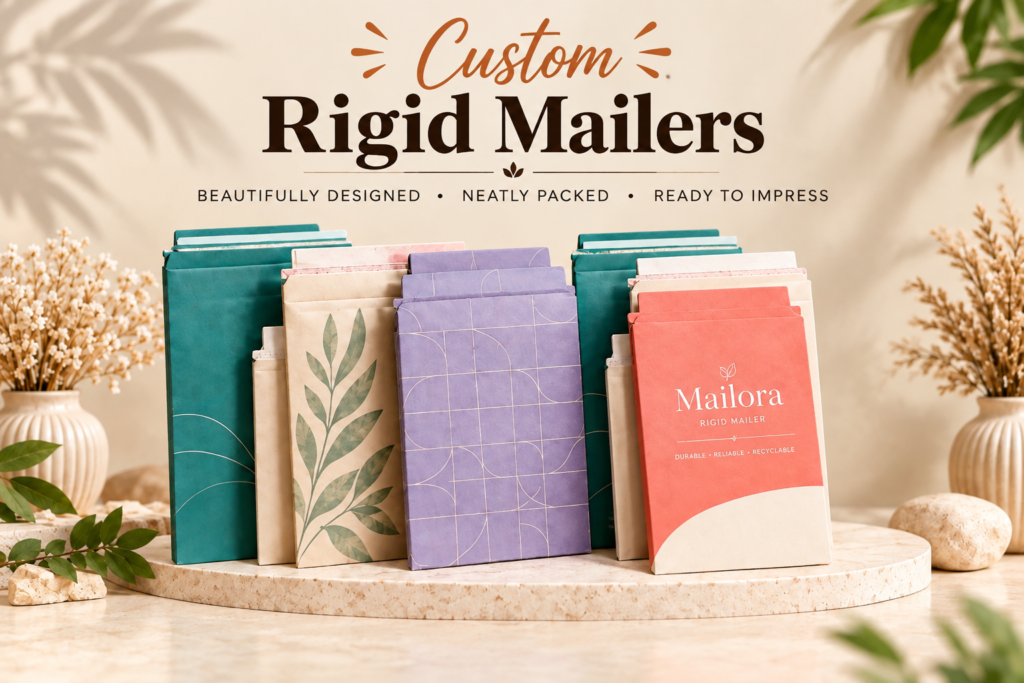
Custom Rigid Mailers: Why Your Shipping Box Might Be Costing You Sales
Here is one. Someone buys something online. The package arrives. It’s bent, damaged, corner squashed in from being under something heavier during transit. Initial thoughts? Wrecked. And they don’t know what the product is.
That’s precisely what custom rigid mailers fix. Nothing glamorous. Not always a pleasure to talk about. But one of the most undervalued packaging moves a brand can make is.
What is a Rigid Mailer?
Good question. This is something in the middle of a flimsy plastic mailer and a full rigid gift box – it’s strong, flat-ish, made to survive transportation without collapsing.
Rigid mailer boxes are made out of a thicker board than a regular shipping box, and generally have a folding or telescoping form that maintains its shape under pressure. Not invulnerable. But lot tougher than cardboard flaps pasted up.
Why brands are shifting to this:
- Additional protection for flat or semi-fragile items (books, clothing, prints, jewels)
- Better unpacking experience
- Diminished returns for damage
- Branding on the outside, not simply on the inside
Custom Rigid Mailer Boxes: Function Before Looks
Let’s start with one item. Custom rigid mailer boxes are not about being attractive. That’s a plus. The primary job is structural – transporting the product from warehouse to doorstep without getting harmed.
But once the structural need has been addressed, then it’s all about the customisation. Options often include:
- Complete external branding (logo, colors, bespoke print)
- Interior printing – effective, people notice this, shockingly
- Easy-open ribbon pull-tabs
- Custom foam or cardboard inserts
- Matte or gloss lamination finish
A clothes brand that ships in a simple brown box or a clothing brand that ships in a branded rigid mailer with interior print? Value regarded completely different. Same product. Another tale is being told.
Rigid Mailer Packaging: For Protection’s Sake
That’s where the value of rigid mailer packaging comes in. Standard mailers. Padded envelope types are acceptable for soft items. T-shirts, socks, that sort of thing. But anything structured? Book covers? Tech accessories? Framed prints? Regular mailers might bend, crush or deform them.
Rigid mailers fix this by:
- Stronger outer shell that does not bend
- Close fit size, limiting internal mobility
- Optional corner reinforcement for more fragile shipments
This is not about appearing pretty on a shelf in a warehouse. But it is what the consumer really receives. Intact, not damaged, presentable.
Premium Rigid Mailers: Too Much for Small Businesses?
Sometimes. Let’s face it.
Premium rigid mailers cost more per unit than ordinary cardboard or poly mailers – sometimes even 2 to 3 times as much. That calculation may not apply to a business that ships bulk low-margin commodities.
But for firms where the product warrants it – subscription boxes, selected gift packages, higher-ticket items – the payoff generally comes in the form of decreased damage claims and improved customer ratings. Fewer “arrived damaged” complaints means fewer refunds and less customer service headaches.
Fast gut check before you go all-in:
- Is your product fragile or susceptible to damage in transit?
- Is your average order value worth the extra expense of packaging?
- Is the unboxing experience and branding part of your customer strategy?
If two or more of these are “yes” then premium rigid mailers probably make sense.
Rigid Mailers Vs Custom Mailer Boxes: Understand The Confusion
These terms are sometimes confused by people. To put it simply, custom mailer boxes versus actual rigid mailers:
Feature | Standard Custom Mailer Box | Rigid Mailer |
Corrugate material thickness | Thinner corrugated | Thicker, more solid board |
Shape retention | Bendable with pressure | Maintains shape well |
Best for | Lightweight, less fragile products | Fragile or somewhat fragile items |
Cost | Lower | Moderate to high |
Branding possibilities | Good | Excellent (inside + outside) |
Neither is uniformly “better.” It’s about aligning the mailer to the real content.
Rigid Shipping Mailers: The Logistical Side Nobody Talks About
Something often missed is that rigid shipping mailers are more than just protection. They also affect the cost of shipping one way or the other.
On the other hand, rigid mailers tend to be lighter and flatter than their boxed equivalents, which can minimize dimensional weight fees on flat items. In contrast, they don’t nest or flatten down as well as certain folding cartons, therefore more storage space is required in a warehouse.
Rigid mailers — worth crunching the math perhaps before you switch over your complete shipping line. Sometimes it’s a no-brainer. Sometimes it’s a wash expense wise but still worth it for the damage reduction and branding value.
Luxury Rigid Mailer Boxes: The Perfect Union of Shipping and Unboxing
Here’s when it gets interesting. Luxury rigid mailer boxes are the line between “just shipping” and “being part of the gift experience.”
Think curated, subscription boxes. DTC Skincare Brands. High-end clothing companies. These brands view the mailer as part of the product experience, not merely a delivery vehicle.
Common enhancements at this level:
- Branded tissue or inside wrap
- Thank You Cards or Inserts
- Custom brand foil stamping
- soft touch or textured exterior surfaces
The aim? Make the delivery moment intentional, not inadvertent.
Rigid Mailer Boxes With Magnetic Closure: A Small Detail That Makes All The Difference
One increasing trend worth mentioning: rigid mailer boxes with magnetic closure. Small integrated magnets keep the mailer closed instead of tape or sticky strips. Opens with an easy pull, no need for scissors, leaving no sticky mess behind.
It’s a little mechanical feel. But it definitely increases the unpacking feel. “When customers aren’t battling with tape and cardboard just to get to their order, they notice.”
Compromise? More expensive to produce and slightly longer lead times than ordinary adhesive-sealed mailers. Not a deal breaker for most brands, but something to consider when planning budgets and timelines.
Questions to Ask When Buying Custom Rigid Packaging Boxes
When choosing a supplier for custom rigid packaging boxes, ask them directly these questions:
- What is the minimum order quantity for a bespoke size?
- “May I see a sample mailer before the full production run?”
- What board thickness/weight do you use?
- Are you using recyclable or FSC-certified materials?
- What’s your best-case scenario?
If a provider is hesitant or delivers imprecise responses to any of them, that’s often a clue to keep looking.
Q: Are rigid mailers superior to normal shipping boxes?
Depends on what’s within. Yes, they offer greater form preservation and protection for flat or semi-fragile goods. Regular boxes are often easier for big or heavy things.
Q: How much extra do stiff mailers cost than normal mailers?
Typically 1.5 to 3 times as much per unit depending on size, thickness and extent of customization.
Q: Are rigid mailers recyclable?
Core being paperboard, most can be recycled, although laminating coatings or foil parts may impair recyclability. Ask your vendor for the details.
Q: What’s a common minimum order size for custom rigid mailers?
Usually 250 to 1,000 units depending on the manufacturer. Smaller runs are available but cost more each unit.
Q: Is the magnetic closing a big cost add?
A little more expensive, typically per unit but many brands feel the better unwrapping experience is worth it.
Q: What is the normal production lead time?
Delivery: 3 to 5 weeks following final design approval, subject to supplier and order complexity. Rush options usually exist.