



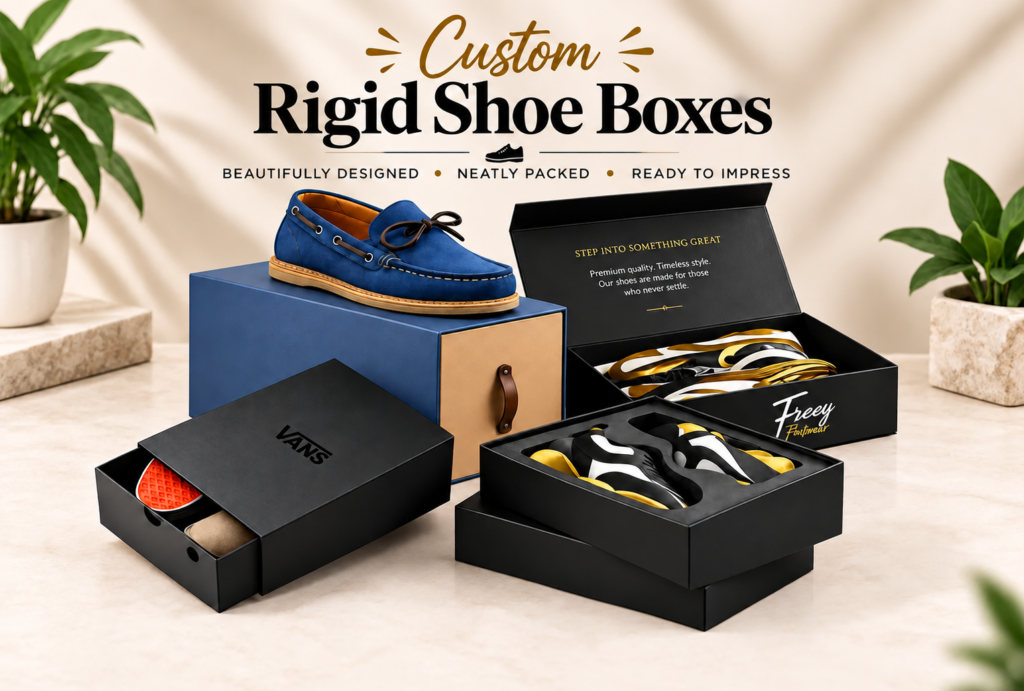
Custom Rigid Shoe Boxes: Why the Box Matters Almost as Much as the Shoe
Just a quick query. Do you throw away the box as soon as you purchase a great pair of sneakers? Or does it remain for some time, perhaps even being utilised again for storage?
It’s not a coincidence if it’s the second one. Custom rigid shoe boxes are doing admirably in that regard.
Packaging for shoes is strangely intimate. Boxes are kept by people. They take pictures of them. Sneaker heads construct whole storage networks around them. Because most packaging never achieves that level of attachment, marketers are now investing more in this area than they did in the past.
Why Rigid Is Better Than Standard, Particularly for Shoes
Let’s take a moment to consider this practically. Shoes are not flat. They’re not all the same. They feature curves, heels, and occasionally sensitive materials like leather or suede that might get dented if they are squeezed incorrectly.
Compared to fragile folding cartons, rigid shoe boxes are superior at handling this because:
- Even when stacked, the structure maintains its shape (shoe retailers sometimes stack boxes).
- During transportation, corners and edges are resistant to crushing.
- Moisture and dust are prevented by the lid-and-base construction.
- They look better on photos and on store shelves.
In contrast, consider a thin folding box. Technically, it functions. However, if you stack five of them, the bottom one will be smashed. For a $150 pair of sneakers, it’s not exactly a fantastic look.
Personalized Shoe Boxes: An Effective Place for Branding
Custom shoe boxes in particular receive greater visual exposure per unit than practically any other kind of packaging, which is an intriguing fact. Consider it. Closets are filled with shoe boxes. They are rearranged. They appear in online “shoe collection” articles, unpacking videos, and resale listings.
Because of this frequent exposure, branding choices are more important here than, say, in a delivery envelope that is discarded after five minutes.
Typical options for customisation:
- Exterior printing in full colour including brand graphics
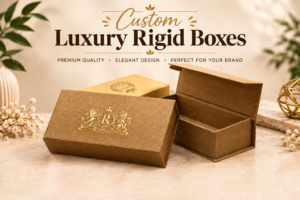
- Foil-stamped or debossed logos
- Personalizedinterior tissue paper with recurring branding
- Cutouts in the window to see the shoe without opening
- QR codes that connect to brand content or authenticity verification
In fact, that last one is becoming more prevalent, particularly with limited editions when counterfeiting is a serious issue.
Luxurious Shoe Packaging Boxes: Why Are They Expensive?
Not every shoe requires this kind of care. Let’s be honest. Luxury shoe packaging boxes are unnecessary for a $40 pair of everyday sneakers since the expense is out of proportion to the product’s pricing.
However, the packaging becomes an integral aspect of the shopping experience for high-end footwear, including designer partnerships, limited editions, and high-end leather products. It may even be included in the resale value at times. A pair of sneakers in their original, undamaged box will fetch a higher price from sneaker enthusiasts. That is not insignificant.
Typical characteristics of this tier include:
- Ribbon-pull or magnetic closures
- Textured or cloth-wrapped exteriors
- Interior spaces for cleaning supplies, spare laces, and authenticity cards
- For a more robust feel, use a board that is 2 mm or thicker.
Custom Shoe Packaging: Juggling Price and Value Perception
Determining the line is a challenging aspect of custom shoe packaging. A high-end sneaker feels undersold and is too simple. An inexpensive shoe that is too ornate seems to have more effort put into the packaging than the actual item.
An approximate structure that usually works:
- $50–$150 retail: mid-tier custom box with logo printing and respectable board weight
- $150+ retail: full custom rigid box, premium finishes, potentially magnetic closure
- Under $50 retail: simple printed folding carton
These are not strict guidelines. However, for firms that aren’t sure where to put their packaging spend, they’re a fair place to start.
Shoe Boxes with Logos: Minor Detail, High Recognition
It may seem apparent, but in brand recall studies, shoe boxes with logo printing routinely score better than generic packaging. A shoe box is seen far more frequently than conventional packaging, and people tend to recall trademarks they encounter frequently.
Interestingly, placement also matters. The lid features a logo that says “classic, traditional.” A branding down the side panel gives it a more contemporary, streetwear-like vibe. Depending on the target market and brand identity, neither is incorrect.
Custom Printed Shoe Boxes: Important Printing Choices
People are typically taken aback by the variety of printing techniques available that go beyond simple ink printing when they enquire about custom printed shoe boxes.
- Offset printing is ideal for big runs, precise detail, and economical at scale.
- For smaller runs or frequent design changes, digital printing is preferable.
- Foil stamping is a terrific way to add metallic touches to limited editions or logos.
- Raised or recessed textures that are embossed or debossed give a tactile, high-end sense.
- Spot UV coating: modest but effective glossy accents on a matte background
Combining two or three of materials, such as a matte base with foil accents and a spot UV logo, tends to produce that “this feels expensive” feeling without going over budget.
High-End Shoe Packaging: An Interesting Comparison
Here’s a quick comparison of high-end shoe packaging with more conventional options:
Features | Standard Shoe Box | Premium Rigid Shoe Box |
Board thickness | 1–1.5 mm | 2–3 mm |
Printing | Basic 1-2 colour printing | Completely personalised, foil, embossed |
Closure | Simple lid | Ribbon, magnetic, or fitting |
Interior | Plain | Particular tissue and compartments |
Durability of stacking | Moderate | High |
To be honest, the practical gap is equally as important as the cosmetic one. Simply said, premium shoe packaging is more durable when handled in the real world.
A Few Errors Made by Designers in Shoe Box Packaging Design
When designing shoe box packaging design, a few common errors appear:
- Forgetting airflow: tiny ventilation spaces are beneficial for some materials, such as leather and some textiles.
- Customers shouldn’t need instructions to open a shoe box because opening methods are too complicated.
- Ignoring stacking stability: Weak corners fail when boxes are stacked in stores and storage.
- Ignoring size verification can result in shoes being damaged during insertion and removal from a box that is a little too tight.
tiny mistakes, but if they are disregarded, they can lead to a terrible consumer experience.
Shoe Packaging Boxes: Sustainability and Sourcing Issues
For good reason, companies that use shoe packaging boxes are increasingly inquiring about sustainable sourcing and recycled content. Customers are noting that footwear packaging has historically used a lot of material for a single product.
Questions to pose to any supplier:
- For custom sizing, what is the minimum order quantity?
- Before committing to full production, is it possible for me to request a tangible sample?
- Which options are available for board thickness and lamination?
- Do you sell recycled or FSC-certified paperboard?
- What is your actual lead time—not the ideal one?
Long-term partners are typically more dependable when suppliers provide precise and unambiguous responses.
Do all shoe brands require stiff shoe boxes?
Not at all. Common folding cartons work well for inexpensive or daily shoes. For high-end, limited-edition, or more expensive shoes, rigid boxes make more sense.
What is the average cost of custom rigid shoe boxes?
Prices range from $2 to $10+ per unit for high-quality custom fabrication and printing, depending on size and finish.
What is the standard minimum order quantity?
300 to 1,000 pieces are typically produced, while some manufacturers charge more per unit for smaller custom runs.
Can recyclable materials be used to make shoe boxes?
Indeed, a lot of providers now provide eco-friendly inks and varnishes in addition to recycled or FSC-certified paperboard.
Do magnetic shoe box closures make sense?
Yes, it enhances the unboxing experience for high-end or gift-oriented footwear. It’s typically an unneeded extra expense for regular retail shoes.
What is the average duration of production?
Final design clearance typically takes four to six weeks, depending on supplier workload and complexity. For an additional fee, rush production is occasionally offered.